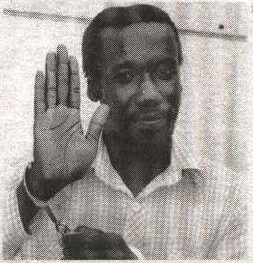
Today, August 1st 2011 marks twenty nine years since the abortive 1982 coup that sought to topple the then dictatorship of former President Daniel arap Moi. Although the coup was quashed by forces loyal to Moi, fundamental reasons why the coup was organized have never been addressed in Kenya while the political and economic maladies that inspired the coup leaders have also not been addressed.
Through the Kenya People’s Redemption Council (KPRC) under which the coup was organized, the coup leaders were struggling against corruption, tribalism, nepotism, cronyism, political opportunism, looting of public resources, dictatorship, poverty, underdevelopment, starvation wages at the barracks, political marginalization of different ethnic groups among others maladies.
Twenty nine years after the coup, significant progress has been made in Kenya’s democratic struggle. However, it is also evident that progress in addressing some of the most critical issues affecting millions of Kenyans has stagnated.
Today, more than 10 million Kenyans are faced with starvation, not because the country is unable to feed itself but because of massive corruption within the ruling class, a crisis of leadership, focus on wrong priorities and neglect of marginalized communities who are also the main victims of the current famine.
Apart from famine, the country is faced with massive unemployment especially among the youth and the ruling class seems to have no solution to the unemployment crisis. Because of the struggle to survive in the face of joblessness, thousands of youths have been forced into crime while many others have lost their lives in the process of stealing to put food in their stomachs. Despite the presence of the Coalition government, millions of working class Kenyans cannot put food on the table due to spiraling inflation that has led to basic consumer commodities like Unga being unaffordable because these workers are living on starvation wages.
Exploitation of the country’s resources by domestic and international agents of capitalism continue unabated under the privatization program of state enterprises supported by the Coalition government whose myopic “Vision 2030” is based on the system of “open market” that has not only failed in Kenya but that is also in deep crisis internationally.
Unfortunately, millions of ordinary Kenyans do not understand that the free market system of government has collapsed and that there is no solution to the country’s problems on the basis of capitalism that has ravaged the country for almost five decades.
After the defeat of the Moi dictatorship through a mass movement that brought President Mwai Kibaki to power in 2002, and after the rigging of elections in 2007 which nearly plunged the country into a civil war, the breed of leaders who took over have failed to transform the lives of millions of Kenyans whose hopes for a better Kenya under these corrupt leaders have faded.
Compensation
Ideological bankruptcy of politicians has led to a resurgence of tribalism and a competition for the emergence of new ethnic chieftains to perpetuate tribal politics which has divided the population thereby preventing them from identifying and fighting the real enemy – the system. The country is lurching from one crisis to another without a political opposition that can put forward a viable alternative to the corrupt ruling class whose conspiratorial schemes to loot the tax payer’s money are never ending.
Under the circumstances, and in view of the twenty ninth anniversary of the 1982 coup attempt, the questions which could come to mind is whether Kenya needs a new coup to topple the corrupt ruling class, a revolution to overthrow the system or a “democratic election” in 2012 to perpetuate the status quo.
In the middle of Nairobi, a monument was erected to remember Kenyans who died in the Second World War, an imperialist war that had nothing to do with the liberation of our country. In almost every region in Kenya where there is a military barrack, there is a British War Cemetery devoted to British soldiers who died during both the Second World War and the Mau Mau war of liberation.
Every year in our country, the British Embassy in Nairobi organizes celebrations to remember and honor “Fallen British heroes” who killed our own people during British colonial occupation. What is pathetic is that at these celebrations, top Kenyan military personnel (Rank of Major and above) are normally incorporated to “salute” at grave yards in memory of fallen soldiers who took away the lives of hundreds of fellow Kenyans during one of history’s darkest hour in our country.
KRA believes that the use of Kenyan military personnel during these rituals should stop while the Alliance also thinks that monuments should be built to honor Kenyan heroes who paid with their lives during the Mau Mau war of liberation and the August 1982 coup attempt. Numerous Kenyans lost their lives during the struggle for political pluralism but now, they have all been forgotten.
The view of KRA is that a government worth its salt should address the issue of compensation to suffering families of the fallen, anti-colonial, anti Moi heroes in our country and this will not happen if a government that recognizes these heroes does not come to power. The Coalition government is not such a government.
Specifically, KRA remembers Hezekiah Ochuka, Pancras Oteyo Okumu, Charles Oriwa Hongo, Robert Odhiambo Ndege, Bramwell Injeni Njeremani, Fenwicks Chesoli Obuon, Joseph Ogidi Obuon, Charles Mirasi Odawa, Walter Odira Ojode, Edward Adel Omollo, James Odemba Otieno and George Akoth Otila whose execution orders were signed by Moi himself. These heroes deserve a monument in Kenya because of the courageous role they played in trying to change Kenya at a difficult time of an iron-fisted one party dictatorship of former President Moi.
Martin Ngatia
Chairman, Kenya Red Alliance (KRA)
About the Author


Tribalism and hate at its worst>http://www.youtube.com/watch_popup?v=w885Ggc9wPw&vq=medium#t=11
This text begins with a big lie. The 1982 coup didn’t try to “struggle against corruption and other evil things”. The coup simply wanted to replace Moi and his cadres with Hezekiah Ochuka Rabala and his friends. Simple opportunists with no particular political agenda except “It is out turn to eat”. Like most kenyan politicans today.
http://www.nation.co.ke/blob/view/-/1230916/data/292384/-/73h62fz/-/where+are+they+now.pdf