

How ECK and Samuel Kivuitu was roped in to help steal the vote

In the eyes of the Kenyan people, it is an accepted fact that ECK rigged elections at the “Tallying centre” at the Kenyatta International Conference Centre (KICC). From events that transpired around ECK before elections, there are very credible indications that the Kivuitu-led electoral body may have been part of the matrix in PNU’s rigging strategy.
In 1997, political Parties signed a deal that became known as the Inter-Parties Parliamentary Group Agreement (IPPG deal) that stipulated that parties that were stakeholders in elections had a right to nominate certain members of the Kenya Electoral Commission. As a result of this agreement just before the December 1997 general election, the then ruling Party KANU nominated Samuel Kivuitu to the Commission while eleven other Commissioners338 were nominated by Kibaki’s Democratic Party, Ford-Kenya, Ford-People and Ford-Asili, the main stakeholders in that election.
Five hours before the expiry of ECK’s ten-year term in November 2007 and barely a month before elections, Kibaki stunned Kenyans and politicians alike by singlehandedly appointing members of ECK including Kivuitu as Chairman who retained his post at the top. Kihara Muttu, the Vice Chairperson, was also retained together with Jack Timwa. Both Kihara and Timwa were nominated to the Commission in 1997 by Kibaki’s Democratic Party and Ford-Kenya, respectively, political parties that were both in Kibaki’s Party of National Unity in the run up to the December 2007 election. When they were nominated by Kibaki in preparation for the December 2007 polls, there was absolutely no room for manoeuvre by other Parties that had a stake in elections because the nominations were done at the last minute and in the heat of campaigns.
Kibaki was a beneficiary of the IPPG deal in 1997, the time when his Democratic Party had the opportunity to participate in the nomination of Commissioners. By doing it alone in the all crucial 2007 elections and by doing so at the last minute, it is very possible that Kibaki’s election office had already included ECK in its strategy because there is no other logical explanation as to why a sitting President could have gone out of his way to single-handedly appoint members of such a crucial Commission without consultation with a concerned opposition that was reading mischief in the move. My thesis is that these appointments were not made earlier because then, the Kibaki strategists could have been faced with the problem of long drawn-out accusations in the media by the opposition that it was planning to rig elections, accusations that were, nevertheless, raised with varying degrees of media attention.
Both Kihara and Timwa, whose terms were renewed by the President, were Kibaki’s supporters and when they were retained in top positions in ECK as others were shown the door, opposition politicians became uneasy because of serious possibilities of bias in a major election that was being contested under serious suspicions after Kibaki announced that he wasn’t stepping down as he promised before he was elected President in December 2002. Former Commissioners whose loyalties could not be verified such as Abuya Abuya, Habel Nyamu, Samuel Manyunza, Stephenson Mageto and Rachel Mzera were all axed and replaced by Kibaki’s loyalists. The sixty-four dollar question is the following: Why was Kibaki retaining some Commissioners and terminating the contracts of others and what criteria was he using to determine who was and who was not to be part of the ECK come December 2007 elections? The Commissioners who were rejected did not indicate their willingness to quit so why were they being denied the opportunity to serve after they delivered credible results without serious complaints in the December 2002 elections, which brought Kibaki to power? If you go by my hypothesis, it was a grand preparation for grand election rigging. The answer to the above question did not emerge until after election when an ECK source told The East African Standard the roles the Commissioners were supposed to play in election rigging. According to this source:
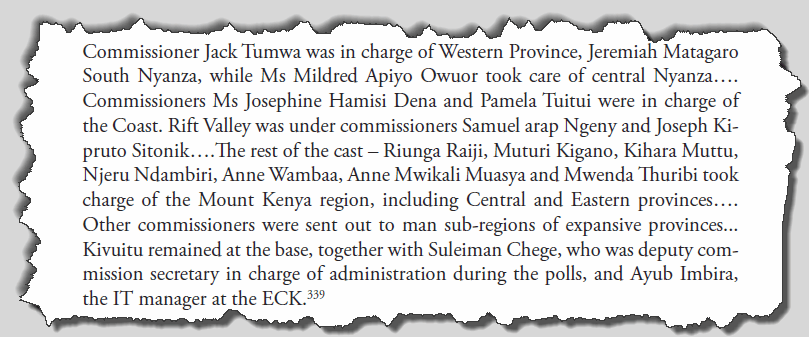
The new faces who benefited from Kibaki’s stunning appointments and who took office at Anniversary Towers where ECK headquarters is based included Samuel Nyanchama Mango, Shem Sanya Balongo, David Njeru Ndabiri, Rachel Wanjala Kileta and Daniel Wasiko Wambura. Naturally, any rigging of election by ECK required that members of the Commission knew, understood and complied with the set agenda and, in my view, this should explain why Kibaki decided to appoint members of ECK single-handedly. As will be elaborated later in this documentation, certain actions of the ECK during the tallying process at KICC become incomprehensible if these actions are not perceived within the context of election rigging conspiracy at the highest level.
When opposition, led by Raila Odinga, raised concerns340 about Kibaki’s sidelining of the IPPG deal that was brokered by the late George Moseti Anyona, it is Kivuitu who was left to respond to their grumblings. In his answer during a news brief that was transmitted by Kenya TV channels, Kivuitu used the legal loophole in the IPPG deal to dismiss allegations that Kibaki was preparing to rig elections. According to Kivuitu, the IPPG deal was a “gentleman’s agreement” that was never written in law. He told journalists that under the Laws of Kenya, the President still had the prerogative of appointing Electoral Commissioners without consulting anybody. He even provided some justification. He said that the IPPG deal has been in existence for ten years and that one could not just come up to oppose it after he (Kivuitu) was appointed to head the Commission. He even wondered what the opposition has been doing all this time.
If there was anybody to defend Kibaki’s decision after he single-handedly appointed ECK members, it is Dr. Alfred Mutua, the government spokesman, and not Kivuitu, who was a beneficiary. Defending Kibaki under the circumstances could be construed to mean that Kivuitu was part of the game. The IPPG deal could have been a “Gentleman’s agreement” but a critical question that Kivuitu did not answer is why Kibaki had decided to breach it since adhering to it could have given more credibility to Kibaki’s willingness to conduct free and fair elections and even cooled down concerns by the Opposition that the President and his team were planning to rig elections, a serious concern that was not in the political interest of Kibaki and company. I wish to argue that the “I don’t care” attitude Kibaki adopted when he appointed the Commissioners single-handedly was based on a long-term plan that was linked to election rigging.
The opposition could not take the matter to court because it is true that the laws had not been changed. They could only give Kibaki the benefit of the doubt and the doubt did become real because Kibaki used the same ECK he appointed to rig elections and install himself as President, opening the way for the post-election crisis. After the rigging, it began to make some sense why Kivuitu was defending the unacceptable move of unilateral appointment of the Commissioners because Kivuitu was himself the “Star Player” as elections were stolen by PNU before live TV coverage and before the eyes of millions of Kenyans. The Kenyan people later took to the streets after they were not only shocked by the blatancy of the rigging but also awed by the brutality with which Kivuitu and company conducted the operation, which was unrivalled in Kenya’s electoral history.
Raila Odinga’s Stolen Presidency:
Excerpt from Chapter Thirteen: Pages: 245-248


The Evil man is dead as Dodo>
http://www.kenyan-post.com/2013/02/former-eck-chairman-samuel-kivuitu-is.html
A new survey has found that a majority of British families are struggling to feed their children with kids sent to school with cold chips or a packet of biscuits.
According to the survey more than two thirds of adults working with children (68.1%) said that in the last two years, they have seen a change in the food in children’s lunchboxes as household budgets get tighter, media reports said.
The survey carried out by the Children’s Food Trust said “some children come in with just a packet of biscuits, or poorer quality sandwich fillings, sometimes just margarine”.
There were “fewer processed items – more leftovers or store cupboard items in the lunchboxes” they survey said, adding “in some ways it is healthier but some families only give cold cooked rice or cold chips with fishfingers or similar.”
The poll, by the Children’s Food Trust, asked more than 250 adults, including youth workers, childminders, teachers, doctors and hospital staff for their views on how children’s diets have changed.
It found that more than four fifths (84.6%) say that in the course of their work, they have seen children who they think are not getting enough to eat.
“The message here is that too many people who work with children are having to go above and beyond the call of duty to try to protect children from the effects of hunger and poor diet. Of course it’s a parent’s responsibility to make sure their child eats well. But as this and other surveys have shown, the reality is that this can be an enormous struggle”, said the Trust’s chief executive-designate, Linda Cregan.
“Whether we like it or not, people working in these jobs are at the frontline of helping parents on this, so they need the right support. As local authorities develop their public health plans, ringfencing funding to support children’s nutrition would be a good starting point”, added the Trust’s chief.
MOL/HE